ECU closed-loop fuel injection control (feedback control)
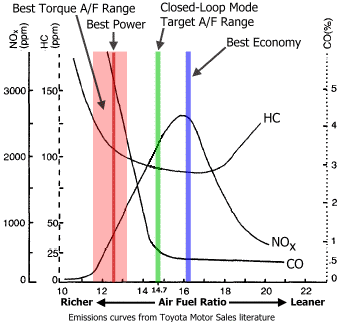
In closed-loop mode, the ECU is using oxygen sensor voltage (see figure below) in a feedback loop to restrict the air-fuel ratio to a narrow range where the catalytic converter is most efficient. That range is A/F equal to 14.7 plus or minus 1% air (0.99-1.01% lambda, where a theoretical lambda of 1.0 equals an A/F of 14.7), or ~14.55 to ~14.85 A/F. The oxygen sensor indicates a (theoretical) stoichiometric air-fuel mixture (A/F equal to ~14.7) with a voltage typically in the range of 0.45 to 0.5 volts. When the sensor output is greater than this range, there is much less oxygen in the exhaust gas than in the atmosphere and the mixture is rich (A/F is less than ~14.7). When there is excess oxygen concentration in the exhaust gas, that is, as the oxygen content approaches that of the atmosphere, the sensor sends a signal less than 0.45 to 0.50 volts to indicate a lean mixture (A/F is greater than ~14.7). If fuel injection is stopped in the engine, oxygen content in the exhaust stream will equal that in the atmosphere and the O2 sensor voltage output will be zero. Typically the ECU uses a reference voltage of about 0.4 V, which is just on the lean side of ~14.7. The ECU reacts to these rich and lean signals by reducing and increasing, respectively, the injector activation duration. By using this feedback control to maintain the oxygen content in the exhaust stream within a very narrow range, the three-way catalytic converter operates at its peak efficiency to reduce carbon monoxide (CO), hydrocarbon (HC), and nitrous oxides (NOx) emissions.
Closed loop mode is used generally during warm idle, low-load cruising, and low-load acceleration to reduce engine emissions. Best fuel economy actually occurs with a slightly lean mixture, with A/F a little more than 16. Despite the need to reduce emissions, there are certain operating conditions where closed loop mode is not used in order to prevent overheating the catalytic converter or driveability problems. These situations include:
While cranking the engine.
During engine warmup when the coolant temperature is below 45ºC (113ºF).
During strong acceleration or deceleration.
During high-load operation.
When the oxygen sensor is not functioning properly.

 View Profile
 View Forum Posts
 View Forum Threads
 Show All Albums
 Private Message
 View Articles
 View Blog Entries


 Reply With Quote


 Originally Posted by keo92stealth


Bookmarks