 View Profile
 View Forum Posts
 View Forum Threads
 Show All Albums
 Private Message
 View Articles
 View Blog Entries

There's no real way to see the limit of timing vs cylinder pressure. You just kinda have to know from experience what's too much or do you normally encounter knock before that happens?


There's no real way to see the limit of timing vs cylinder pressure. You just kinda have to know from experience what's too much or do you normally encounter knock before that happens?
'92 Dodge Stealth RT/TT - Aug. 2012 COTM
note that there was no knock in any of the simulation cases. knock pressures are much higher because there are multiple flame fronts.
Maddog Performance Engineering
10 degrees of timing makes a hell of a difference on my car, using straight pump fuel I have to pull 17 degrees at some points in my map to avoid knock showing on the logger.
I`ve recently been adding 20% methanol (by volume) to the fuel in the tank and it`s night and day difference, can add 10 or more degrees of timing back in and the car flys!.
not when I first got into the 8's, I ran 8.81@166mph with no timing control whats so ever (955 whp). and yrs worth of running 9's, and 10's in meny cars.
I only put on the ITC when I put in the 1000 cc injectors (pressure cranked up and 2 625ML meth nozzles, making 1093 whp at that time, and running 8.74@168 with lots of tire spinn), and it still was fine with it set to 0 it just made a little more power with a few deg of timing PULLED out on the dyno.

Well it depends, one thing to note is that peak torque may or may not be reached before an engine starts to knock. I have tuned engines where knock has occured before MBT is reached. I have also tuned engines where there's a significant amount of room for more timing advance between where peak volumetric efficiency occurs (which is peak torque) and when knock starts to occur. In these engines, if you add timing after MBT, the engine will lose significant power, but may still not knock. So, it is not safe to say that peak torque will be reached just before the point that an engine begins to knock. This means that even if you have a good method of knock detection, adding timing up until the point just before knock occurs will not always result in an ideal torque output, net the most power, or maintain the highest area under the curve.Originally Posted by B-Man

The best way to establish an optimum spark timing mark is to inspect your plugs. There's a test called a spark plug hook test. You warm your car up, gap your plugs, do a full pull and then pull the plugs and inspect them. Where the ignition signature lies on the sparkplug hook dictates wether your timing is early, late, or dead on.
Jeremy
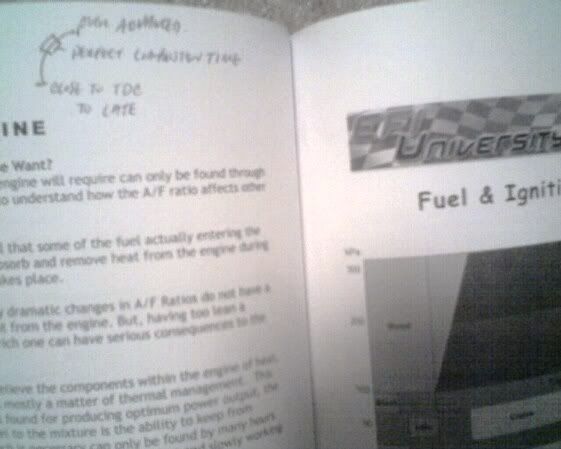
It is true ignition timing is dependent on fuel type due to different ignition points and kernel speeds. However, when utilizing any fuel you may revert to the spark plug hook test. The ignition signature on the spark plug grounding electrode will allow you to determine the optimum ignition time, regardless of fuel. As illustrated here in my EFI University Notes:
Jeremy
That's interesting because we went over that exact concept (PV diagram) this morning in thermodynamics lol. What's your major?
91 R/T TT
Mods: RC 550s, Stillen Downpipe, Stillen Cross-Drilled Rotors, HKS Exhaust, HKS VPC, HKS EBC, HKS Turbo Timber, HKS Twin Power, HKS SSQV BOV, HKS SMIC, HKS Fuel Pump, Wiseco Pistons, 3SX Rods, Ferrera SS Valves, 3rd Gen Lifters, 15G Turbos, Centerforce Dual Friction Clutch, B&M FMOC, Unorthodox Racing Underdrive Pulley, EGR blockoff.
Mech E. you'd be surprised how much you use engineering in some fields of work, and absolutely none in others. i guess i'm one of the lucky ones
Cool same here. Feeling like there is no end to this major atm though. Thermo, statics, diff eq, and tech comm...all kicking my ass.
junior year will be even worse
 Posting Permissions
|
3000gt.com 3000GT / Stealth International WWWboard Archive Jim's (RED3KGT) Reststop |
|
Team 3S 3000GT / Stealth / GTO Information daveblack.net |
|
Michigan 3S MInnesota 3S Wisconsin 3S Iowa, Nebraska, Kansas 3S |
North California 3000GT/Stealth United Society of 3S Owners 3000GT/Stealth/GTO Forums 3000GT/Stealth International |
|
3S National Gathering East Coast Gathering Upper Mid-West Gathering Blue Ridge Gathering |

 Reply With Quote
 Visit Homepage
Bookmarks