 View Profile
 View Forum Posts
 View Forum Threads
 Show All Albums
 Private Message
 Visit Homepage
 View Articles
 View Blog Entries

I see, I don't recall ever seeing a set for sale during my time here, that is something I would of bought.
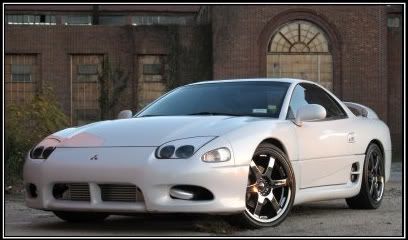
I have managed to get some nice parts thus far
TEC Performance front bar
TEC Performance rear bar
Saner sway bars
Cianci 96 Stealth Spoiler


I see, I don't recall ever seeing a set for sale during my time here, that is something I would of bought.
I have managed to get some nice parts thus far
TEC Performance front bar
TEC Performance rear bar
Saner sway bars
Cianci 96 Stealth Spoiler
2" piping can handle 500cfm while staying below 300mph (around where airflow becomes turbulent) and is at about 260ish mph.
Stock piping at 1 5/8" actually only handles about 300cfm before air becomes turbulent.
Assuming stock throttle body is 60mm (don't have my caliper up here to measure the opening) the speed of 1000CFM (total of 2 cores supporting 500cfm each) is 350+mph and would be turbulent. A 70mm throttle body would allow 1000cfm of flow at about 270mph.
In short, 2" is about the sweet spot with stock TB. For cores that can flow 700CFM-800CFM each though, you'd want about 2.5" piping to maximize it with a 3.5" Y pipe and TB inlet (assuming you have the turbos to match it.)
Mods: 2g 3k body conversion, 2g Brake upgrade, Rota P45R rims
Projects: Interior sound deadening, 14Bs, forged bottom end, custom radiator and sound mounts
How would 1 3/4" piping flow which is what I'd be offering for the most part. This is probably what 90% of what people would need.
Originally Posted by sergechronos

"Life should NOT be a journey to the grave with the intention of arriving in an attractive and well preserved body, but rather to skid in sideways, chocolate in one hand, martini in the other, body thoroughly used up, totally worn out and screaming "WOO HOO what a ride!"
----------------[2007 Ride of the Year.................................. 3.5 Stroker I did.w/DBB DR1000's
I'm not a smart person so I'm going to need a little help understanding.. Sorry. Lol.
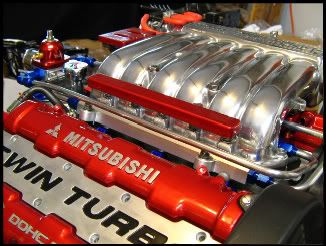
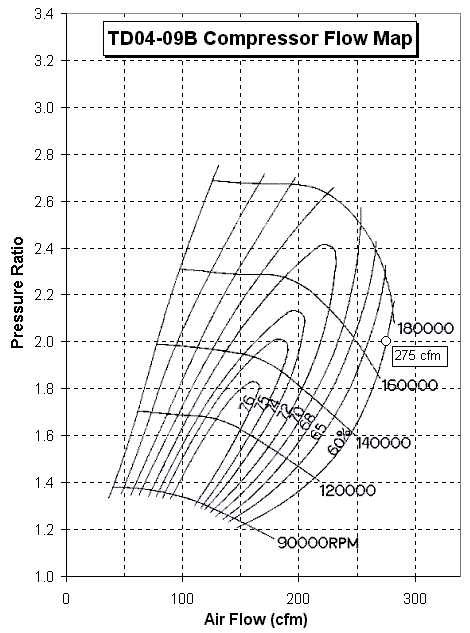
So since our stock 9bs flow roughly 275CFM each, our stock piping works rather well for the designed application since it keeps its under the 300mph turbulence area.
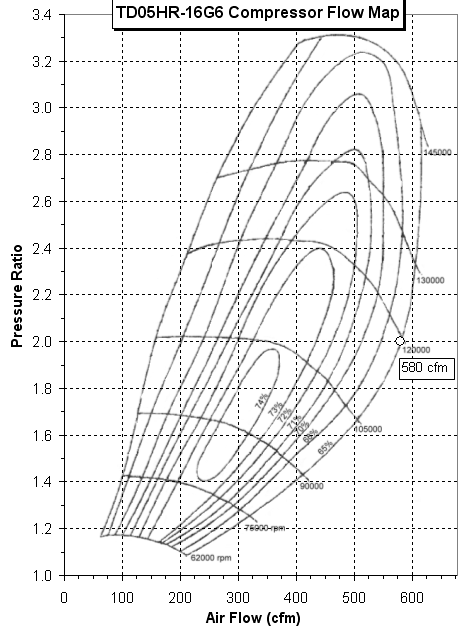
Now say a larger flowing turbo such as a EvoIII 16G/DR750 which flow quite a bit more, the 2 inch piping would be more ideal as it keeps the flow at around 260mph give or take.
However when the two are combined at the y pipe and go into the throttle body, the combined flow into the throttle body can become turbulent again as our stock 60mm with 1000CFM flows at 350+mph. Now the same flow at a 70mm throttle body would drop it down to roughly 270ish which puts it back in the ideal range.
If its not too much trouble, could you explain the math? I'm interested in learning more about this. Or if there's a formula to figure this stuff out, that would work too.
So most of our billet cars would actually benefit from running 2" piping and a larger throttle body. In theory, even 2.25 would be beneficial for those running maxed out billet setups which flow higher than 500CFM each?
Would doing something like this be beneficial? I thought about it years ago but I remember most people disregarding it as a waste of money when I asked years ago.
6G 72 Turbo Throttle Body Rebuild
Last edited by vTaKwiTHsLiCkS; 07-25-2014 at 09:18 AM.
1.75" piping (assuming ID?) can do about 430cfm (roughly 15Gs) before air starts to become exceedingly turbulent. The stock throttle body (at 60mm diameter) would be at about 320mph which is just over what we would want to see. That said, we have seen guys put up big numbers with turbos flowing more than that with stock piping (Ray's DR650 car for instance) however engineering says that they would actually see gains from bigger IC piping and cores at that point, and upgraded TB and potentially intake manifold, although I believe the inlet on the IM is slightly larger than 60mm but would need someone to measure it.
A throttle body rebuild is always beneficial as our seals tend to harden and crack and allow air to escape. Contact dbest on the forums to get yours rebuilt, think it's less than 135 as well but not sure. It definitely is worth it so that you're getting all the air your turbos are pumping.
As far as the piping size, it goes back to what happens inside of pipes. Airflow becomes very turbulent and starts to experiences losses that increase exponentially once air speed goes past .4 mach (which is around 305mph.) With each turbo producing 275CFM (for a total of 550CFM when merged back together) the stock piping is fine and the stock TB is plenty sufficient. However, yes once running 15Gs or 16Ts you are at the upper limit for what the pipes and TB can handle without hitting that point, I'd say that probably has quite a bit to do with why you get somewhat diminishing returns on turbos past that point without upgrading your intercoolers. I'd be interested to see what Ray might put down with his DR650 car upping just the intercoolers, then upping the ICs and piping. He'd still bottleneck at the TB a bit, but would be interesting. By the time you're running DR650s or E3 16Gs (where you're seeing over 500cfm at 20psi with room for more boost) you're well past the turbulent area.
Keep in mind though, this is forced induction so these things are not quite as detrimental for us as they would be if an NA were capable of moving 1000CFM of airflow and tried to do it through 60mm piping. It is still an inefficiency that should be minimized if possible though. I wouldn't go bigger than 2" hot side piping if I was Bob though simply because very few owners would be able to use it so there's no sense spending the money developing it.
As to the math for going from CFM to MPH:
Divide the CFM by the cross sectional area of piping (pi x r^2), multiply by 60 (number of minutes in an hour) and divide by 5280 (number of feet in a mile).
Example:
275 cfm to MPH in 1.75" piping
1.75" = .1458'
radius = .1458'/2= .072916
radius squared = .00532 ft^2
r^2 * pi = .01669
275 / = 275/.01669 = 16476.93
114.39 *60 = 988615.8
988615.8 / 5280 = 187.238mph
500cfm to mph in 1.75" piping
500/.01669 = 29958.06 *60=1797483.52 / 5280 = 340.43
Ray has DR750's and DNPerformance piping. The large SMIC's I'm making for him will have 2" piping. Hoping to have them in his hands by next Saturday.
Will 2" be a option?
Or are we waiting to see what 2" piping will net using Rays car as the test subject?
I'm running DR650s with stock piping, stock TB, and stock SMIC. I've been able to get 400whp on 91 and 450whp on 101 octane running down to 10.5 AFR to try to keep intake temps down. I hit around 16 psi and 18 psi respectively before I get limited by knock. I believe the SMIC is my biggest bottleneck in performance right now. My plan is to get Oohnoo's SMIC and see if I can push to higher levels without knock, leaning it out to 11 AFR as well. I also have a Z06 + MAFT in case I'm limited there. But I do think I'm in prime position to show the gains from stock to much bigger SMIC
Yes 2" will be an option. Ray's only going with the 2" cause he wants as much flow as possible to get the most out of his turbo's as he's shooting for 700+ which we're hoping these will give him that.
You have to remember the hard part about all this was designing the end caps for both side and also the brackets to mount them. Now that I have that all designed and made the pipes are the easy part. I already have jigs made for all this from converting DSM IC's which believe it or not still get lots of requests to make.
Prices will vary accordingly.
Standard configuration for most people will be SMIC's with 1 3/4" piping with 1 5/8" adapters welded on the ends for oem setups with end caps welded on the outside only.
Then you have these Options:
SMIC's with 1 3/4" piping for DNP or CXRacing piping - no adapters
SMIC's with 1 3/4" short pipes welded on, can be straight or semi curved as seen in pics below
SMIC's with 2" piping for DNP or CXRacing piping with 1 3/4" adapters welded onto the ends like my DualCore setup. even though the DNP pipes are 2" they taper down to 1 3/4".
SMIC's with 2" piping for DNP or CXRacing piping with no adapter on ends -
SMIC's with 1 3/4" short pipes welded on, can be straight or semi curved as seen in pics below
SMIC's with 2" short pipes welded on, can be straight or semi curved as seen in pics below. Reason for difference is the end caps are cut for a 1 3/4" hole. I would then have to enlarge them for the 2" pipe.
End caps welded both inside and outside. For the most part all the after market end caps I've seen have only been welded on the outside. But if you want the extra reinforcement I am offering this option.
My end caps are made with 1 3/4" holes for that size piping, so using 2" piping I'll have to enlarge them will will be an added expense. Just have to figure how long it will take me to enlarge the holes which will determine the extra cost. Same with the other options....added welded adapters etc.
You also have to remember if going with 2" piping that the opening on the drivers side will have to be enlarged.
If anyone needs anything different please let me know as I can custom make it for you. But basically all orders will be custom made for your piping needs using the Bell cores (8" x 4.5" x 8.1and the end caps I designed.
PIC WITH SHORT PIPES. Can be either 1 3/4" or 2"
PIC OF END CAP
PIC OF MY CONVERTED DSM IC's WITH 1 3/4" PIPING....THIS IS WHAT THE PIPES WILL LOOK LIKE FOR EITHER 1 3/4" OEM SETUPS OR 2" DPN SETUPS
 Posting Permissions
|
3000gt.com 3000GT / Stealth International WWWboard Archive Jim's (RED3KGT) Reststop |
|
Team 3S 3000GT / Stealth / GTO Information daveblack.net |
|
Michigan 3S MInnesota 3S Wisconsin 3S Iowa, Nebraska, Kansas 3S |
North California 3000GT/Stealth United Society of 3S Owners 3000GT/Stealth/GTO Forums 3000GT/Stealth International |
|
3S National Gathering East Coast Gathering Upper Mid-West Gathering Blue Ridge Gathering |


 Reply With Quote




Bookmarks