 View Profile
 View Forum Posts
 View Forum Threads
 Show All Albums
 Private Message
 View Articles
 View Blog Entries

shouldn't matter. torsional forces should (theoretically) be less on a shorter crankshaft.Originally Posted by donniekak




shouldn't matter. torsional forces should (theoretically) be less on a shorter crankshaft.

What do you mean not very strong? GTR has v6 and it made 1600whp on aluminum block. the strength is actually in to materials and block design. yes there is more surface bearing on crank which can help with less bearing wear but also more friction, but with very good oiling system which would work the same on any engine you can make a v6 very reliable or inline 6 unreliable if you don't have good oiling system. inline engines have room issue so they can't be made from thick casting so the cylinder walls are not as thick and also they can't be made with large valves because they design them to be as short as possible. in results smaller pistons and smaller valves and less flowing cylinder heads. don't look at 2jz. other inline 6s came no where near 2jz engine. I can grantee you our block is way stronger than any other gas inline 6 engine out there. looking at the block you can see how mitsubishi strength the block from top and sides. it looks like a diesel engine block. we just need someone who can push it to the max after finding a solution to keep the heads seal which i think i did. Saf is going to try this on his car soon. most 2jzs are actually half filled when reaching over 1300-1400whp. Nelson't car is making easy 1300whp if it was on rwd car and the block is not even sweating. rb engines can crack cylinder wall if push pass 1100 1200 hp.
Last edited by mehrshadvr4; 04-20-2013 at 09:48 PM.
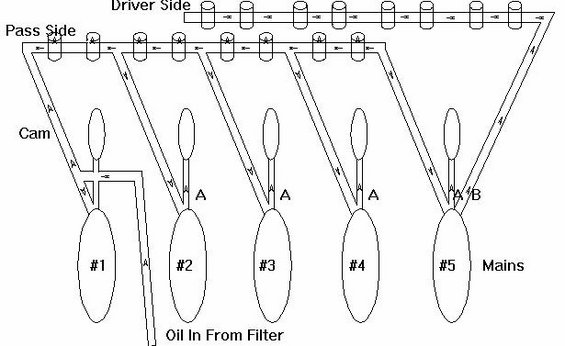
The blocks in these cars were originally developed as 150hp minivan engines. The center 2 mains each feed 2 rods, and a port for the a cylinder head. A real performance design has what's called priority main oiling, where the crank is fed first, and the cylinder heads afterward. The fact that Mitsubishi put such small restrictors in the galley to feed a 12 valve dohc cylinder head is proof they knew the oiling system was a problem. No wonder why the lifters tick. All the oil in the head has to pass through this.

debonair is not a minivan
You should know it better the tt engines have nothing in common as other 6g engines specially the sohc block. also they put restrictors there because cylinder heads don't need as much oil. rb26 people put even smaller orifice restrictors for the head to reduce oil flow to the head to keep oil down in the block and have less oil drainage problem.almost all engines come with that. as far as center main feeding two rods it's same in any other v or w engines. v8,v12,v16,w16,w12,w8 all use the same concept.if the engine is design right they will give it enough volume to feed two rods. priority main oiling is on all cars even ours and since the heads have restrictors there is a very small effect on main bearings.looking at this ohv v8 should have the worse oiling system then and it's priority main oiling like any ohv engines. look the mains have to feed two rods and cam shaft and the heads at the same time. ours there is small hole on front and back to bleed some oil to feed the heads. if the orifice is too big this cause oil pressure drop and too much oil goes in to head (like rb26) and it'll drain the mains and oil pan (like rb26).
I watched the 80s turbo engine built and they feed the heads just like our car. from the center of oil gallery, but it was external fed because of making casting and such simpler.
Last edited by mehrshadvr4; 04-21-2013 at 06:20 AM.
Well, I've been proven wrong. Old v8s spun rods like nothing, and 6g72 dohc engines have no issues with wiped center mains and spun rods.
The crank in a 91-92 vr4 is the same crankshaft that was in millions of 80's minivans. Mitsu bolted dohc cam heads, and 2 turbos on them. Should have worked out fine right?
That's where the issue was. putting cast and weak crank on turbo cars. I think even the 4 bolt blocks have weak crank and also the oil pump is not good enough for the engine. I would love to see the oil flow comparison between na and tt oil pump. I bet the is little to no difference between the two and TT oil pump has to pump oil to two turbos and oil jets right where the mains are and oil cooler. In my built i'm going to block the turbo oil feed lines on the oil pump and get the oil from the head where they are already done lubing the bearings and i'll also block the oil jets. this should improve the oil flow to the bearings. people right now have much more reliable engines with stronger crank also.
I will need to remove the heads in order to replace those, won't I? I installed a rebuilt engine in my car and immediately noticed that the oil pressure was lower than before... Then I researched and discovered that it is rather typical for machine shops to remove those when skimming heads and they never get installed back after that. That is why a number of people observe a low oil pressure after rebuilding their heads... I am so upset that it drives me crazy! How bad is it to drive the car without the orifices and how long would it take before it csuses serious damage?
2jz is an inline 6. 2jz is also God's gift to boost junkies/enthusiasts
2jz > all other 6 cylinder motors
Therefore...
Inline 6 > v6
95 TD05 16G VR-4---540whp@24psi
34XXlbs..
I've never such an advocate for the 6g72 like you...Do you have 6g72 posters on your bedroom wall?..

 Posting Permissions
|
3000gt.com 3000GT / Stealth International WWWboard Archive Jim's (RED3KGT) Reststop |
|
Team 3S 3000GT / Stealth / GTO Information daveblack.net |
|
Michigan 3S MInnesota 3S Wisconsin 3S Iowa, Nebraska, Kansas 3S |
North California 3000GT/Stealth United Society of 3S Owners 3000GT/Stealth/GTO Forums 3000GT/Stealth International |
|
3S National Gathering East Coast Gathering Upper Mid-West Gathering Blue Ridge Gathering |

 Reply With Quote

Bookmarks